Why your selfies do not look like you, and what to do about it
If you have ever thought you look worse in selfies than in photos other people take of you, you are right, and it is not your face. It is the lens, the distance and the mirror, and all three are fixable.
The lens is too wide and too close
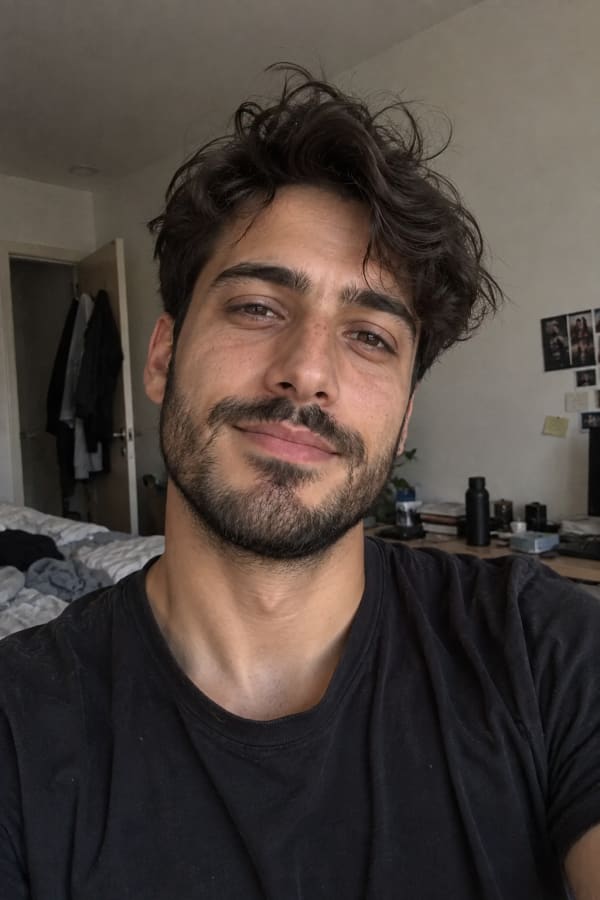
A front-facing phone camera is a wide-angle lens held at arm's length, which is around 30cm from your face. At that distance a wide lens exaggerates whatever is nearest to it and shrinks whatever is furthest. Your nose is nearest. Your ears are furthest.
So a selfie makes the nose larger, the forehead broader, the jaw narrower and the ears smaller than they are. Photographers shoot portraits at 85mm from two metres away precisely to avoid this. That is not a flattering trick, it is the geometry that renders a face at its true proportions.
This is why the same person can look markedly different in a selfie and in a photo taken across a table. The face did not change. The distance did.
The mirror problem
Your phone shows you a mirrored preview, and many phones save the mirrored version. You have seen your face mirrored your entire life, so the mirrored version is the one that looks correct to you, and the un-mirrored version looks subtly wrong.
Everyone else has only ever seen you un-mirrored. When you dislike a photo other people think is fine, this is frequently why. Faces are asymmetric, and you are noticing your own asymmetry from an unfamiliar direction.
And the light is usually above you
Selfies are mostly taken indoors under ceiling lights. A source directly overhead puts shadow in the eye sockets, under the nose and under the chin. It is close to the lighting used to make people look sinister in films.
A window is the single biggest available upgrade. Facing a window, with the light in front of you rather than above or behind, fixes more about a photo than any camera setting.
What converting a selfie should and should not change
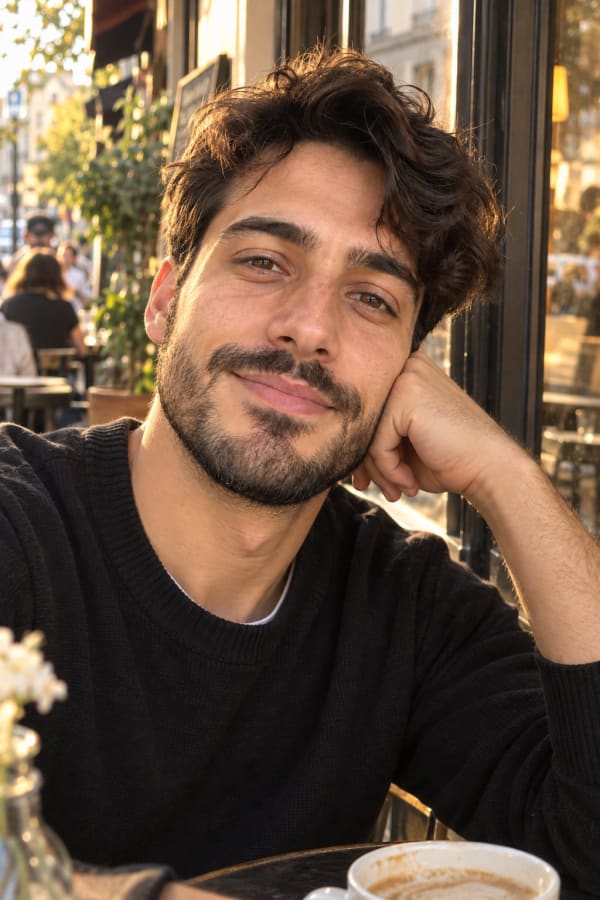
The right conversion fixes the circumstances: renders your face at portrait distance and focal length, puts a soft source in front of you, puts a real room behind you, and writes a file that behaves like a photograph, with grain appropriate to the light.
There is a trap here that is easy to walk into. If a selfie makes your nose look wider and your jaw narrower, it is tempting to "correct" that. But correcting selfie distortion and beautifying a face are the same operation, and a tool that starts doing the first will not stop at the second. So the rule is that your real proportions are copied as they are. Getting the lens and the light right is what makes the photo look like you. Adjusting the face is what stops it.
Where these photos go
Settings that work
Common questions
Why do I look worse in selfies?
A front camera is a wide lens held about 30cm away. That enlarges your nose, widens your forehead and narrows your jaw. Portrait lenses are shot at 85mm from two metres for exactly this reason.
Are selfies an accurate representation of my face?
No. They distort proportions through lens geometry, and many phones save the mirrored preview, which is the version you recognise but nobody else has ever seen.
Why do I look different in the mirror than in photos?
The mirror is flipped. You know your face mirrored; everyone else knows it un-mirrored. Faces are asymmetric, so the two genuinely differ.
Can you turn a selfie into a professional photo?
Yes. The selfie supplies the identity, and the render supplies portrait distance, lighting, background and a file that behaves like a photograph.
Should the conversion fix selfie distortion?
Only through the lens and the distance, never by editing the face. Reshaping a jaw to compensate is the same operation as beautifying, and it stops the result being you.
How do I take a better selfie in the meantime?
Face a window, hold the phone slightly above eye level, and use the rear camera on a timer if you can. The rear lens is less wide and the distortion drops sharply.
From $14.99/mo · Cancel anytime